
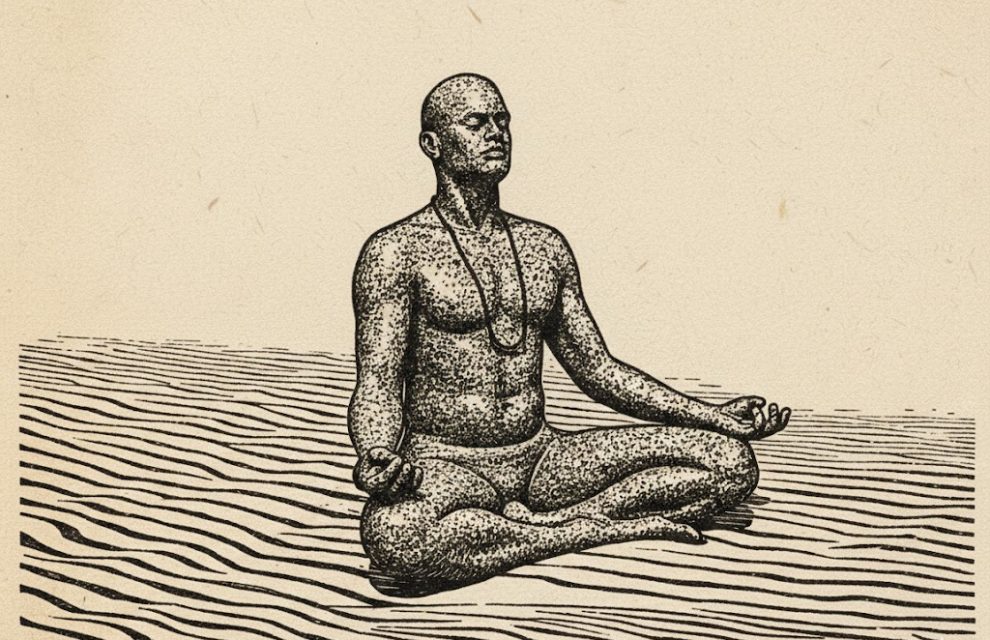
Over the last few weeks, I have become fascinated by a specific yogic power (siddhi) mentioned in traditional texts, particularly the Shiva Samhita: Vigraha-siddhi. This term does not translate easily into English due to its immense cultural weight.
In Sanskrit, Vigraha generally means “body,” “form,” or “physical manifestation,” while Siddhi means “perfection” or “attainment.” Together, they represent the “Perfection of Form.”
From Idol to Practitioner
In India, Vigraha is most commonly associated with religious ceremonies where a deity is invited to inhabit a statue. Once this occurs, the statue is no longer seen as mere stone; it is treated as a living being. It is awoken, washed, dressed, anointed, fed, and prayed to.
The deity now lives in the statue.
You can of course read about this whole process in the Corpus Hermeticum.
In the context of yoga, however, Vigraha-siddhi describes the practitioner becoming a “living statue” for the Divine. Unlike the sudden consecration of an idol, the yogic journey is a gradual transformation. The ancient texts provide a roadmap of milestones to ensure the practitioner is moving toward true perfection rather than merely enduring physical strain. I am sure anyone reading this can immediately think of other traditions and religions where this also exists.
The Milestones of Transformation
As the practitioner cultivates divine energy, the body undergoes a radical shift. It starts with a rigorous progression of purification that begins with the generation of intense internal heat during practice, manifesting first as profuse perspiration and rhythmic trembling as the Prana begins to stir. As the practitioner advances, the body sheds its gross impurities, resulting in a distinct sense of physical lightness and a radiant, lustrous complexion accompanied by a sweet, resonant voice. Each one of these changes brings around improvements to the functional ability. At this stage for example the practitioner can move as fast as a wild animal.
This internal cleansing eventually balances the gastric fire, rendering the yogi free from disease and causing the body to emit a pleasant fragrance rather than offensive odors. In the deeper stages of mastery, the practitioner achieves the “frog jump” or levitation as the body becomes buoyant, the joints and bones become incredibly firm and resilient, and the pulse grows steady and calm. Imagine the physical form becoming harder, stronger, and more resilient, like a statue—eventually becoming immune to damage and needing less rest. The body regenerates to a youthful state, senses become enhanced, and the mind quickens. Ultimately, this leads to a state where the physical form becomes a perfected vessel, characterized by total sensory control and a body so stable that it remains motionless and undisturbed by external stimuli.
Ultimately, the practitioner becomes a custodian of the Divine energy within, transforming the body until it exists beyond ordinary physical needs.
The Daily Ritual of the Self
One compelling aspect of this concept is the analogy of Hindu worship (which we also see in other traditions). In a temple, the deity follows a daily routine:
- Morning: They are awoken and moved from passive rest.
- Mid-day: Their environment is cleaned, their clothing changed, and they are offered food, incense, fire, and recitations.
- Evening: They are undressed, clothed for the night, and returned to restful peace.
Reversing the Perspective
The physical outcomes listed are wonderful and fascinating but what I have really been musing on is the whole idea of being a container for divine light.
What if everything you associate with “you”—your personality, memories, and achievements—isn’t actually the most important aspect of the Self? Could it be that you are a temporary custodian for divinity? If so then identifying solely with your body or ego is as confused as mistaking a stone statue for the God it holds or your clothing for yourself.
There is something important in this insight that I think may be empowering and bring a new level of focus. Could it be that we might benefit if we thought in terms of guiding and controlling our mind and body to allow for the expression of pure goodness and enlightenment from within? A surrender to the higher self to allow it to express itself and shine though all other aspects of the self.
This allows us to view our daily lives as a continuous offering. Every time we sleep, dress, eat, or speak, we are performing a ritual for the Divine spirit residing within us.
If we apply this to Vigraha-siddhi, a shift in perspective occurs. One of the earliest effects of this siddhi is said to be fearlessness, particularly regarding death. This may not just stem from increased health, but from a shift in identity.
Shaping the Stone
This contemplation might also bring about a change in how we view spiritual exercises. In the creation of a temple statue, the stone is shaped and then blessed with elements of Earth, air, fire, and water. This is necessary for the divine spirit to be able to reside within. Similarly, in systems like Yoga or Franz Bardon’s Hermetics, we prepare ourselves through specific “shaping” actions:
- Structure: Performing Asana to shape the “stone” of the body.
- Purification: Eating correctly and washing the body.
- Invocation: Using mantras and affirmations to invite specific qualities.
- Blessing : Mastering the use of the elements and other forces.
By conditioning the body through the elements and meditation, we are not just exercising; we are preparing the vessel to house a higher state of consciousness. This change of viewpoint—from “self-improvement” to “divine invitation”—may be the heart of the genuine yogic transformation.