
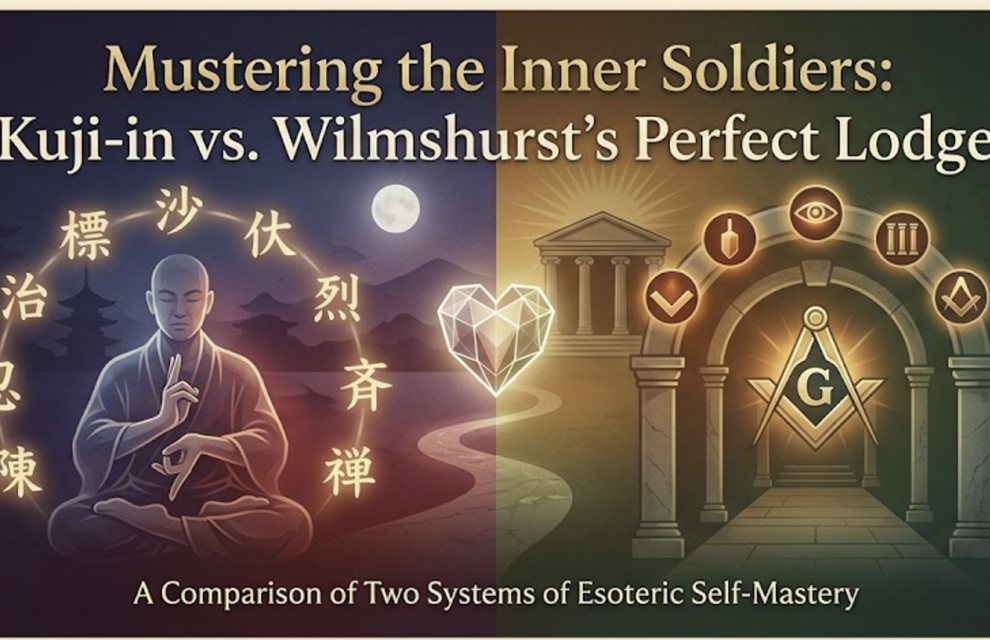
The journey to self-mastery often involves conquering the chaotic landscape of our own minds and spirits. Ancient traditions, whether Eastern or Western, recognized that this was not a task to be taken lightly. They understood that to achieve true enlightenment or internal harmony, we must cultivate specific faculties and align them, much like an army preparing for battle or a lodge convening for ritual.
This post will explore two fascinating, yet distinct, systems that visualize this internal structure: the Kuji-in of esoteric Japanese Buddhism and the “Perfect Lodge” of Western Masonic esotericism, specifically as articulated by W.L. Wilmshurst. By comparing their “inner soldiers”—the complete lists of the nine syllables and the seven principal Masonic officers—we can gain a deeper understanding of the universal principles of esoteric self-cultivation.
1. The Core Concept: Internalizing the Divine
In both traditions, the “soldiers” or “officers” are not external entities, but faculties of consciousness that must be awakened. The body is the temple (or the battlefield), and the practitioner is both the architect and the general.
-
Kuji-in: Derived from Shugendo and esoteric Buddhism, these Nine Syllables (and their associated hand gestures, or mudras) represent levels of power, cosmic laws, and divine entities. The practitioner “arms” themselves by manifesting these energies within their own body to achieve Satori (enlightenment) or protection.
-
Wilmshurst (Masonic Esotericism): In The Meaning of Masonry and his descriptions of the “Perfect Lodge,” the Seven Principal Officers (three master-lights and four subordinate officers) represent the constituent parts of the human spirit. The “Lodge” is the self, and it is only “perfect” when these internal officers are in their proper places and functioning in harmony.
2. The Complete Muster: System by System
Here are the complete lists of the “inner soldiers” and their esoteric functions within their respective systems.
The Kuji-in (The Nine Syllables)
The Kuji-in functions sequentially, building from a base of physical stability toward the manifestation of divine presence. They are often grouped as four “defensive” and five “offensive” symbols, representing the duality of protecting and projecting one’s inner power.
| Syllable (Kanji) | Meaning (Typical Translation) | Esoteric Internal Function |
| 1. Rin (臨) | Strength | The “Source”: Base of power. Physical and mental integration, rooting the consciousness. |
| 2. Pyo (兵) | Direction | The “Will”: Channeling and directing vital energy (Ki). Focusing intent. |
| 3. To (闘) | Harmony | One-ness with the universe or self. Balancing internal forces. |
| 4. Sha (者) | Healing | Restoration of self and others. Activating the “internal sun” or vital center. |
| 5. Kai (皆) | Intuition | Sensory awareness and premonition. Feeling the intentions of others. |
| 6. Jin (陣) | Awareness | Mastery of thought and emotion. Control over perception and the flow of information. |
| 7. Retsu (列) | Dimension | Creation of sacred space. Control over elements and the “line-up” of the faculties. |
| 8. Zai (在) | Creation | Control over reality and the manifestation of divine will in the physical world. |
| 9. Zen (前) | Enlightenment/Absolute | The “Apex”: Reaching the ultimate state of “absolute” presence, emptiness, or Satori. |
Wilmshurst’s “Perfect Lodge” (The Seven Officers)
Wilmshurst organizes the Lodge officers as a reflection of the sevenfold structure of the soul, divided into three principal “greater lights” and four subordinate “lesser lights” or linking mechanisms.
| Officer | Location | Symbol | Esoteric Internal Faculty |
| 1. Worshipful Master | East | Square (Virtue) | The Spirit (Pneuma): The Divine Principle or Higher Self. The ultimate authority and source of wisdom that rules the Lodge. |
| 2. Senior Warden | West | Level (Equality) | The Soul (Psyche): The “Moon” or psychic principle; the bridge and chief executive that governs the lower nature. Reflects the Master’s light. |
| 3. Junior Warden | South | Plumb (Rectitude) | The Mind (Nous, Intellect): The “Sun” or illuminated intelligence. Midway between spirit and matter, testing and proving all things. |
| 4. Senior Deacon | South/East | Dove (Messenger) | The Divine Link: The messenger or adjutant of the Worshipful Master. Links the Spirit (East) with the Soul (West). |
| 5. Junior Deacon | South/West | Dove (Messenger) | The Rational Link: The messenger of the Senior Warden. Links the Soul (West) with the lower sense-nature (South/refreshment). |
| 6. Inner Guard | Interior Portal | Sword/Portal | The Inner Sense-Nature (Astral): Challenges all incoming thoughts or impulses from the lower nature to protect the inner sanctuary. |
| 7. Tyler | Exterior Portal | Sword | The Outer Sense-Nature (Physical): Guards the outer door against “profane” influences (sensory input) that could disrupt the work of self-perfection. |
3. Functional Parallels and Key Differences
| Concept | Kuji-in | Wilmshurst’s “Perfect Lodge” | Functional Alignment |
| The Power Source | Rin (Strength): The base of power. | The Junior Warden/Tyler: Represents the physical nature/external senses that provide the raw “bricks” of material. | The grounding point. |
| The Intent | Pyo (Direction): Channeling energy. | The Senior Warden: The chief executive governing the soul/will. | The mechanism of intention. |
| The Authority | Zen (Absolute): Ultimate enlightenment. | The Worshipful Master: The Divine Spirit, apex of being. | The ruling consciousness. |
| The Link | Zai (Creation)/Sha (Harmony): Elements/Inner sun. | The Deacons: The messengers between higher and lower mind. | Transmitting divine wisdom. |
Key Philosophic Contrasts
-
Active Martial vs. Contemplative Architect: The Kuji-in is often viewed through a martial, “Soldier” lens—it is about hardening and protecting the spirit for active engagement and protection against chaos. Wilmshurst, conversely, focuses on the “Architect” and the deliberate, contemplative process of building a stable, ordered interior temple where the Divine can be seated.
-
Ascent vs. Descent: The Kuji-in progresses upward, from the base (Rin) toward the ultimate state of enlightenment (Zen). Wilmshurst’s model emphasizes the descent of the Spirit (The Master in the East) into the material world (The West) to organize and enlighten the chaotic lower nature.
The “Inner Soldier” Summary
Both Kuji-in and Wilmshurst’s Lodge are serious, spiritual practices focused on mastery of the self. In the Kuji-in, you are arming the self to meet the challenges of the universe. In Wilmshurst’s Lodge, you are ordering the self to reflect the harmony of the universe. Both traditions agree: a person who has not “mustered their troops” or “seated their officers” is a house divided, vulnerable, and unable to achieve true mastery.