
In this short article, I would like to present an interesting and challenging idea. I would like you to contemplate whether the highest attainment in self-development and spirituality could be hidden right in front of you. Rather than being found in a long-lost mystical book, or passed on by a teacher in a Himalayan cave, these secrets may lie straight under your feet, right where you stand. And not only do they bring the best outcome for all, they are also the source of the highest possible attainment.
There is a Zen phrase, often seen at the entrances of monasteries and temples and heard on retreats: kyakka shōko (脚下照顧), “watch under your feet”, or simply “under your feet”. It is used in several different contexts, but all of them connect to the same underlying idea: dealing with what is immediately your responsibility.
I find this concept a very interesting one, because it has many different levels to it, some of which, once explored, may prove far more important than a first look would reveal. So let us contemplate “under your feet” and some of its higher meanings.
And this is where I want to take it. My belief is that if you fully engage with the most mundane things in your life, you may reach the very highest attainments, the ones I have so often sought elsewhere, through exotic mystical and magical practices. Many of the artificial measures we take, the training rituals and meditations of the spiritual paths, but also the weighing of food for a diet or the habit tracker on the wall, are very positive and wonderful in their own respect. Yet I suspect that they are not needed by someone who fully embraces the moment.
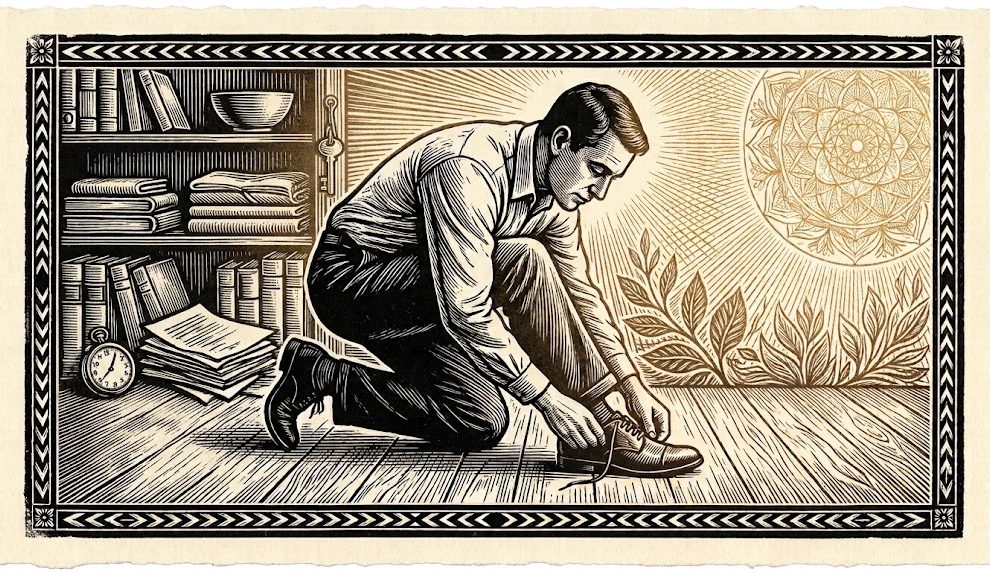
First and foremost, there is some symbolism here, both in Zen and in the wider contemplation of the phrase. In Zen there is very much an idea that a person’s state of mind can be discovered by seeing how they do trivial things, and the classic example is where you put your shoes when you enter the temple.
The thought is that where you place your shoes on entering a house or building shows something of your state of mind. And it is not just about shoes. It is about how you do all sorts of small, seemingly meaningless, day-to-day tasks, the ones where you decide to put off the perfection, or the tidiness, until the future. You come in through the door and, rather than putting your shoes in the shoe rack (a very big thing in Japan), you throw them on the floor, where others trip over them.
There is a lovely story told among the Hasidim about Rabbi Leib Sarah’s, a disciple of the great mystic the Maggid of Mezeritch. He used to say that he did not go to the Maggid to learn Torah from him, but to watch how he tied his shoelaces.
There are other actions like this that probably exist in your life as much as they do in most of ours: putting our keys or our mobile phone down somewhere at random; coming back from a trip and leaving the bag unpacked; doing the lazy thing in the moment, which leads to a lot more work later on, or gets in the way of other things, so that when you need to find something there is clutter everywhere. All those moments when you decided you would do it tomorrow.
And these small decisions have a knock-on effect. The shoes might not trip up my wife, but they might cause enough clutter and distraction that she too puts something down and cannot find it. The muddled cupboard, which might seem laughable to tidy, is probably not saving any time at all. It is causing confusion. It means you don’t know what you have or what you need to get, and it takes time to find things.
The concept of “under your feet” opens up some wider considerations, and here are a few of my own. I have been musing on how many of the actions I take seem to be a shortcut, or less effort, but in fact lead to greater confusion, hardship or hard work in the future. Sometimes, for example, I try to save time when talking to my friends, my staff or my wife, believing that a quick summary will let me get on to something else, only to have to go back and explain things again in more detail, having discovered that my brief explanation was substandard, confusing, or led things in a completely different direction. Often, with projects I want to get finished, I start to confuse the finishing line with the goal and lose sight of the reason I am doing the job, and then there is quite a bit of work to do to put things right.
I want to be clear here. I am not saying that we should seek the highest degree of perfection in everything we do. The reward-to-effort ratio certainly matters when it comes to everyday tasks, including where we place our objects and how much information we pass on. I am simply talking about balance: the best amount of effort, thoroughness and detail, not too little and not too much, to bring the best outcomes. So why is it so often less? Why do we neglect our immediate tasks when we could certainly do better, and why don’t we change? And what does this mean for our own path, our consciousness and our enlightenment?
From the Zen point of view, one of the problems with our state of consciousness is that we are so often putting things off into the future. One of the ways we avoid embracing our full ability, or our full responsibility, is to decide that it will happen later. There are various Zen teachings on this, and phrases that can be used to keep our mind on the matter: there is only now; there is no tomorrow; if not now, when? In many Zen monasteries the wooden board struck to call the monks to practice carries the same reminder: great is the matter of birth and death; life is fleeting; awake, and do not waste this life. To some degree, then, not looking beneath our feet, not doing what is in front of us to the best standard we can, is a way of denying our higher consciousness and our perfection. We are putting it off. But perfection cannot be saved for later. If it is to happen at all, it has to happen now. And if we can learn to stop putting off doing things properly in the moment, we learn to stop putting them off in our lives, because a life is made of nothing but moments.
For me, however, there are some other very important things to consider. For almost all of my life I have been focused on big things, and found it frustrating, confusing, even pitiful, that people are so obsessed with the small ones. Why are people concerned that their socks match, or that the towels in the cupboard are folded correctly? Why make efforts towards small things that make no difference on the big scale? In the truth of the big picture, what does it matter whether the cans in my cupboard are in order or not?
I have discovered in life that we often hide our inability behind disdain. If you are not very good at the normal day-to-day, a really good way to protect yourself emotionally is to create a persona of mystical brilliance, one that is far beyond caring about mundane matters like scraping the car or offending the vicar. And it is great when it turns out that you are too important, too mysterious to understand and too holy to blame for anything you do wrong, because, in truth, it is just the muggles trying to get you to conform to their world view.
But this position was one of ignorance. I did not realise that I only had a limited time here, and that all things are one: nothing is separate. That is rather a big concept to put across in two lines of a blog, so please allow me to elucidate a little.
Look around you. Everyone has a limited time, and what they do echoes in eternity. It cannot be redone. It cannot be changed. You cannot go back and pick up the rubbish you dropped, or clean your teeth properly. Perhaps, after all, everything is of extreme value, because this moment is never going to be repeated.
But there is more. We tend to think in terms of inside and outside, of thoughts as immaterial and physical objects as material. Depending on the situation, we pretend that one or the other is the real thing. When we have bought someone a present, we say “it’s the thought that counts”, yet surely the physical object counts too: where it was made, where the money went, whether it is useful, whether it is fit for purpose. At other times we switch it around, and when we tell someone that something is just in their head, suddenly the thought doesn’t count. Often we pretend that some things aren’t real, when in fact everything is. Parmenides taught that the great secret was that what is, is, and what is not cannot be: there is no nothing, and so everything is real. The Rosicrucians tell us something very similar. Among the sayings inscribed in the vault of their founder, Christian Rosenkreutz, is one of their greatest secrets: “Nequaquam vacuum”, nowhere is there a vacuum.
Our thoughts, our intentions, the movement of objects, the communication between people: all of these are one wave pattern of thought and existence. The shoes in the doorway, the cans in the cupboard, the hurried explanation to a colleague: each is a ripple in that same pattern.
If everything is real, then we might want to look more closely at the subtlety behind it. What if your actions, and the order of your objects, are not separate from you or your thoughts? What if they are not merely a reflection, but all things united? Think about how your objects are arranged. Many a Zen practitioner will tell you that to reach some of the highest states you most certainly need the right environment, and you only have this moment to make that happen.
I have come to believe that all things, in some sense, have a resonance and a consciousness, and that all movements and all actions have a higher outcome than you can see. You are a small spark of consciousness, and how you do things, and how you arrange things, is in a sense the thought pattern that you represent. Paying attention to the mundane, whatever you are doing, and doing it with awareness and to the best of your ability, is also a way of engaging the learning aspect of your mind and your higher awareness. This may sound a little far out, and I will write more about it in a separate blog. But if we want to raise the consciousness of our race, and indeed of the world, we need to start with ourselves, and we need to start in the moment, because the moment is the only chance we have.
But isn’t it a bit of a strain, doing this all the time? Isn’t it very tough? I thought the same, but my thinking has started to move. At first I wondered whether practising the Zen art of doing my best, fully engaged, in every moment would be overwhelming: too tough, and no way to live. Then I thought back to certain meditation practices where I felt the same way at the beginning. In some of them I longed simply to relax into the state of mind, but relaxing lost the state of mind. It may be that later, after a great deal of training, less force is needed. But at first, an ongoing reminder to be fully in the moment is essential.
This is where those artificial measures come in. Think of someone who, every time they exercised, really did exercise, searching out the borderlines of their body’s limits in a safe and sensible way. They would not need a coach, or a record of their lifts. Think of someone who, every time they sat down to eat, made sure the plate in front of them held the most blessed food, the food that is best for their body. They would not need a diet plan. The trackers, the logs and the plans are there to do the remembering for us, because we are not fully present.
When I muse on watching under your feet, I find myself thinking about it on many different levels. Under your feet is you, here, right now. It is your presence here. What do you want your presence to stand for, and what do you want to do with this very moment? I have come to believe that it is not possible to reach a higher state of consciousness, or enlightenment, without a change in attitude towards whatever is happening in this very moment. Always remember that this is not a rehearsal. This is your turn, and your only opportunity to do whatever you are doing now to the highest of your ability and its best expression, to bring the best outcomes. You will never get to do it again. And in the end, it is not really for you. You want to do everything just right for everyone else: for the people around you, and for the whole world beyond them.
There is a story about the discovery of the Emerald Tablet. A statue of Hermes bore an inscription telling anyone who wished to know the secret of creation to look under its feet. Crowds came and looked beneath the statue’s feet and saw nothing, until Balinas dug down beneath it and found the hidden chamber where the tablet lay. I wonder whether the right place to look was beneath their own feet.
It is from the Emerald Tablet, too, that we have the phrase “as above, so below”, and it applies here as much as anywhere. How you do one thing is so often how you do everything. Learning to be fastidious and disciplined, to do things with your full heart and to engage with them emotionally, is certainly part of our advancement.
There is a Buddhist tradition that lotus flowers sprang up wherever the Buddha stepped, and Thich Nhat Hanh taught his students to walk as though a flower blooms beneath every step. I think I know what they meant.
When you engage fully with what you are doing, you begin to connect with the underlying energy of it. And as your level of awareness rises, an awareness of these hidden things starts to develop of its own accord.
You can see where this practice might lead for some people. I am absolutely sure that if we were to engage fully in small matters, we would become increasingly in tune with subtle things: more empathic, more understanding, and eventually perhaps even able to communicate directly in a higher way. I believe that if we were completely tidy and clean in our lives, our thinking would be pure and unobstructed, and we would see the world as it really is, not as we wish it to be, nor as it has sometimes been presented to us.
And sometimes, I think, spiritual exercise itself can become a displacement activity. Why are we seeking to be able to do extreme things when we cannot remember the simple ones that would aid everyone around us? Genuine, full engagement is probably going to be more powerful than any artificial adaptation, which is really only designed to squeeze out a little more focus and thoughtfulness.
Many people spend their time reading the different mystical traditions and teachings, learning philosophies, and memorising rules and correspondences, yet in truth they are not paying attention to the lessons that life is presenting straight in front of them. If, using this principle of under your feet, they saw every single moment as a chance to interact on a higher level and to evolve themselves, there would be lessons enough.
Looking back, I have found that many of the big experiences I have had, and some of my greatest lessons, came about because they allowed me to glimpse what is there in the moment. I had not realised it, but it took extreme measures for me to pay attention to what was directly in front of me.
Perhaps how we tidy, how we read, how we speak, how we drive, how we work and how we sleep, if fully embraced, would all eventually lead to a higher state. Could it be that the most extreme siddhis, or abilities, we have ever heard of in yoga or other practices are achievable through the mundane? And that, in truth, the artificial exercises put in place to advance us are simply means of undoing certain blockages, no longer needed once we fully embrace our potential, our oneness, and most of all, the moment?