
It would be fully understandable for anyone reading this article to be confused by the title at first. Zen, after all, is very much concerned with a single focus. The word Zen itself derives, by way of the Chinese Chán, from the Sanskrit dhyāna, meaning meditation, or focus on one thing. The practices of Zen centre on being single-minded, with full focus and genuine dedication, whether the practitioner is sitting, cleaning or going about day-to-day life. Each task should be seen as a means to achieve samādhi, or zanmai as it is called in Japanese.
Awkward questions
A few years ago, a friend and I were questioning a Zen master about this very subject, and we asked him all sorts of awkward questions. If you are meant to achieve full focus while doing things, couldn’t that be dangerous? If you went into a state of samādhi while driving, wouldn’t the car crash? He replied, “If you crash the car, then you haven’t entered samādhi.”
Then we asked him: if you are meant to do one thing at a time, what if you are driving and people keep talking to you? What then? What if you are trying to eat and someone asks you for directions? He told us to focus on the primary thing, which is driving the car, and to do as much as we could to discourage distractions, but to be polite about it.
Real life in the outside world, however, isn’t always so simple that you can just bat away the secondary demands on your focus.
Beginner’s advice
What we didn’t understand at the time was that this is beginner’s advice in Zen. To begin with, you need quite a strong idea of what you are doing. But as your focus improves, you can begin to broaden the mission with a sense of inclusion. The new mission can be “driving with my friend”. Although the primary purpose is still to drive safely, the talking and the enjoyment of it are now part of the mission too.
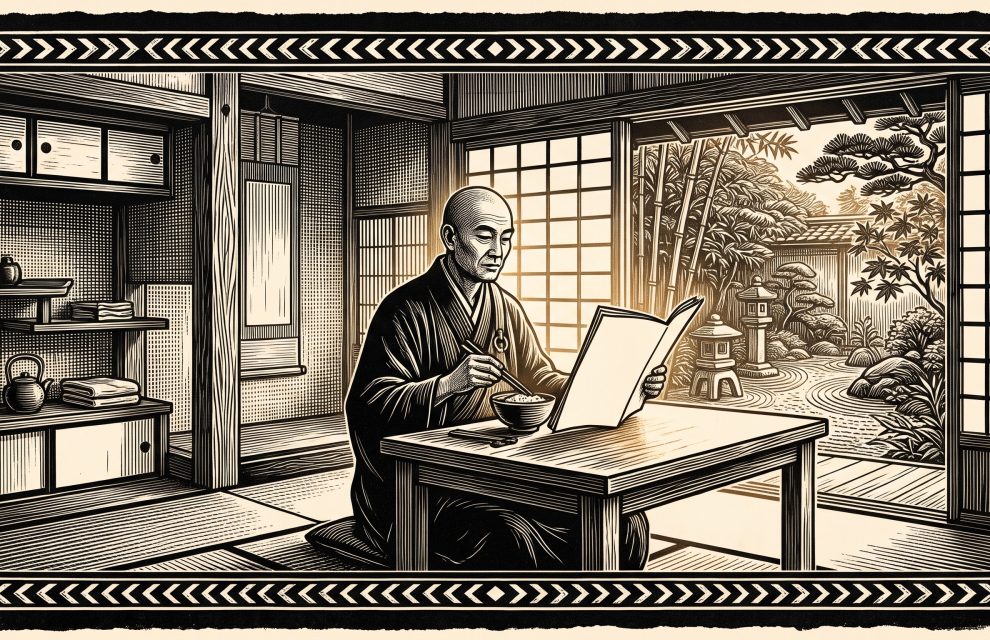
This is well demonstrated by a story about a modern Zen master. The Korean Zen master Seung Sahn used to teach his students, “When you eat, just eat. When you read the newspaper, just read the newspaper.” One day a student caught him reading the newspaper over his meal and asked, “Master, you always told us to do one thing at a time. Why are you eating and reading?” Seung Sahn replied, “When you eat and read the newspaper, just eat and read the newspaper.”
This story often catches us off guard, because we tend to think Zen is about rigid, black-and-white rules, such as the fixed idea that doing two things at once is always wrong. But true Zen is not about sticking to dogmatic rules or holding on to fixed ideas about how life should look. Instead, it is about learning to work fluidly and mindfully with things as they actually are in the present moment.
Applied to modern multitasking, this means that juggling several responsibilities does not automatically break your mindfulness. If you must handle more than one thing, the practice is to bring your whole, undivided awareness to everything you are doing right now, fully engaging with the situation as it is rather than scattering your mind in anxiety or distraction.
What counts as one thing?
So how strict are Zen practitioners about this? The answer is: not as strict as you might think. Zen is actually very practical. Doing one thing at a time is not a rule about separating out every movement of the body. If it were, you couldn’t breathe while walking, or eat with a knife and fork. The “one thing” is really the whole of what is happening in the present moment, not one small item on a to-do list.
What you are aiming for is mushin, which means “no-mind”: a clear, open awareness that stays steady even when you are busy. The trouble is never that two things are happening at once. The trouble comes when the mind is split, when part of it is still hanging on to what you were doing ten seconds ago instead of being with what is happening now.
The same is true when driving with a friend. If the traffic suddenly gets difficult, the driving needs all of your attention, and a mindful driver will simply say, “Give me a second while I pull out,” without getting flustered or feeling guilty about it.
A change of focus
This applies just as much at work. Anyone who has to get on with their own work while being constantly interrupted (a manager with a team, for example) will know the problem. The answer isn’t to stop the interruptions; it is to learn to switch cleanly from one thing to the next. If you are writing a report and someone knocks on the door, it isn’t really their question that causes the stress. It’s trying to keep half your mind on the report while the other half listens to them.
So first, put down what you were doing completely. Take a breath, take your hands off the keyboard, and let it go.
Then make the person in front of you your one thing. Turn to face them and treat the conversation in the spirit of ichigo ichie, as a meeting that will only happen once. You will find that a minute and a half of real attention usually sorts out their problem far quicker than five minutes of half-listening.
If what you are doing really can’t be interrupted, then telling them so becomes the one thing. Stop, look at them properly and say, “I want to give this my full attention. Can we talk at two o’clock?” Then go back to your work with your whole mind.
Finally, don’t carry anything over. When the conversation is finished, let it go as cleanly as you picked it up, and go back to what you were doing. The Japanese call this fudōshin, the immovable mind: a calm, balanced state that isn’t knocked off course by interruptions.
Harmonisation and incorporation
As you continue to practise the art of doing one thing at a time, fully focused on the task in hand, you may find that certain areas of your life need a different approach. For example, if you work in a busy office, you may not be able to sit down and spend a whole hour answering emails as a form of meditation, because there are phone calls and questions from others. In this case, it’s time to expand, harmonise and incorporate, and to start viewing that time in a different way: your job is to answer queries, whether they come from phone calls, emails or someone coming into the office.
Likewise, there may be times in your personal life when you’ve been asked to help someone with a DIY task or with something in the garden, but your allies in this mission seem remarkably off target, and it’s very hard to get them to apply themselves. In this case, you may need to harmonise their goals with your own, and look at it as a time to enjoy an activity with friends in a gentle, light-hearted way.
At heart, this skill is about making unavoidable disturbance your ally in any dedicated undertaking, and bringing it into your sense of what is needed. In rare cases, you may even need to use distraction as a motivator, the new mission being to keep focused during special training in cold and noise, or to remain tranquil, a figure of peace, in stressful circumstances.
Ultimately, make sure that when you multitask, you only do one thing at a time.